
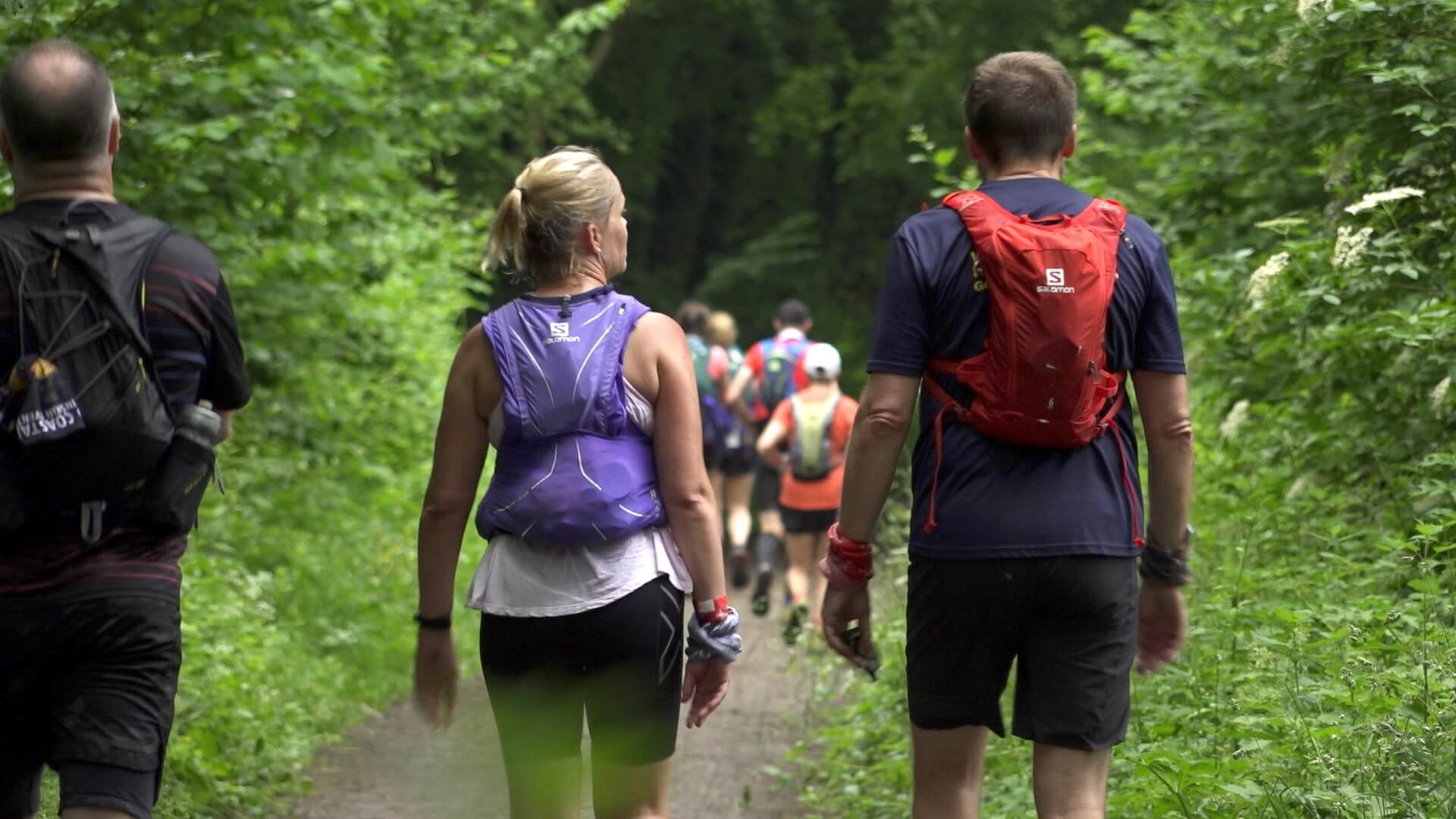
The definition of Sport Walking is ‘walking strongly with a purpose for fitness, challenge or adventure’ but it’s challenge that drives everything and binds all the different aspects of it together.
Sport Walking encompasses walking for fitness, challenge walks – either for personal fulfilment or to raise money for a good cause – and bigger, adventurous walks in wild places.
The characteristic that flows through each way of Sport Walking is that you move fast – you walk at speed. That doesn’t mean race walking (although you can if you want), you simply walk ‘normally’ fast because that enables fitness gains, it enables you to achieve challenge goals and it facilitates longer, more impactful adventures.
All three applications – fitness, challenge, adventure – test you. Simply getting fit is a challenge, walking challenges are, by definition, challenging and when you layer on adventure – going into remote or testing environments – then challenge really comes to the fore.

But Sport Walking is so much more than just what you do when you go out on a challenging walk. It’s a way of approaching the very act of walking itself, viewing it as a sport, seeking to get more out of it, to use this most simple of activities to have a fulfilling and, in many cases, life enhancing experience.
It IS what you do, not the way that you do it….!
Sport Walking isn’t a specific walking style, or technique, like Race Walking, Nordic Walking or Power Walking – you can go ‘Sport Walking’ using any walking technique you like because the way you walk isn’t important, it’s having some kind of challenge objective that counts.
Regardless of your overall priority, in Sport Walking, you approach your everyday workout or training walks with the same focus – you walk fast, seeking always to push yourself because that’s how you make progress. This gives you your baseline activity, whether it’s all about getting or staying fit or about preparing for something further down the line.

Then you can apply this ‘training’ to a walking challenge situation if you wish. This could mean taking part in an organised event, such as Parkrun (in the Parkwalk group) or one of the many charity challenge events that have become so prevalent like ‘Oxfam Trail Walker’ or the ‘Ultra Challenge Series’. You might also want to set yourself a personal challenge, like walking a National Trail in the fastest time you can.

All that matters is that you approach each walk as a sporting endeavour, have a goal, go as fast as you’re able to and have one foot on the ground at all times!
At ‘Sport Walk’ we’re working to promote and establish Sport Walking as a key fitness, challenge and adventure activity. Our motto is ‘Move fast, go light, challenge yourself’ and this perfectly sums up all that Sport Walking is.
Rise to the Challenge
Although there’s no compulsion to take on Sport Walking challenges, they are a hugely empowering component of Sport Walking overall. Once you’ve gained some fitness through Sport Walking, the way to keep motivated is to keep testing yourself and Sport Walking challenges, whether they’re organised events or your own personal ambitions, offer an endless supply of adventurous experiences, giving greater purpose to your day to day walking.
Challenges shape everything you do as a Sport Walker because that’s where the sport lies. What’s important is that challenges are progressive – they change with your ability. When starting out you may simply have a goal to walk for five kilometres, in the style of ‘Couch to 5k’ but once you’ve achieved that, what next?
This is where, often, simple fitness plans using walking can fall short but not with Sport Walking! Sport Walking adds that layer of challenge to the fundamentals of walking effectively for fitness and this challenge layer is what gives you the motivation to continually progress.
Without it, repetitious workouts can become tedious and that can mean you lose interest but with Sport Walking, because you achieve fitness through something bigger than just the exercise itself, you’re focused on what’s next and that means that you never struggle for motivation.
This is why we created our fitness focused Sport Walking strand – ‘Get Fit Walking’, which is both a series on Youtube and a key workout session offered by our Sport Walk Trainers, who provide ‘in person’ training within their communities. The key here is ‘purpose’ and that’s why Sport Walking is defined as ‘walking strongly (fast) with a purpose’.
You’re motivated to take on another challenge because the last one fulfilled you so much and it’s this purpose that can deliver long term fitness and health growth. It’s all about consistency over time and when you’re continually motivated to take on another challenge and another, you’re not thinking about your fitness progress, you’re just thinking about that next buzz you’ll get from achieving your next goal.

Focus on Performance
When you adopt a Sport Walking approach, whether it’s purely with a fitness objective in mind or, perhaps, because you’re looking to take on a challenge, a key tactic is to view your walking as a sport. After all, it is called ‘Sport Walking’! This might be a major mindset shift but it’s a really valuable shift to make.
The ideal, is to start approaching your walking as an athlete would approach any sport – to think of what you do as training, to consider how you can improve your performance, to refine and optimise your walking style. All these elements will bond together and the net result will be that you’ll achieve more (whether that be going longer, going faster or achieving fitness more effectively).

You may wonder why you need to view your walking as a sport, to adopt an athlete’s mindset or to focus on performance. Why can’t you just walk faster and be done with it? Well, it’s all about harnessing sports psychology to get better, faster results for yourself. To achieve more, whether that be better fitness or more scope for your challenge ambitions.
An athletic mindset gets you locked into a way of doing things that will make all your actions more effective and that means that the gains you’re seeking come easier. If you’re aligned with your sport, seek to learn from what you do so you can improve and dedicate yourself to that improvement, then you can’t fail.

Embrace Tech
Measuring your progress, so you can be always motivated is another really valuable trait to adopt. You don’t just want to go out walking without any record of how you walked, how far you walked or how fast you walked because then that experience on that day is lost to you.
So tracking all your workout or training walks so you can monitor and assess your performance is incredibly valuable. You could log your time vs distance and work out your speed and pace manually on paper but sports watches and online apps give you so much information that it’s well worth embracing tech and going digital.

Apps on your phone like Strava are a great and free way to start tracking your sessions by giving you basic pace, speed and distance data that can build up into a record of achievement. You can look back through all your sessions and see for yourself the improvements you’re making.
If you’re working to a speed target or have a goal to be able to walk a certain distance in a certain time, this data can show you exactly where you are now, so that you can plot what you need to do to achieve your goal.
Measuring your performance like this is one of the aspects of Sport Walking that does actually distinguish it from some other types of ‘athletic’ walking, particularly those like Power or Nordic Walking, which are often promoted more as being about getting an all over physical workout.
Just Get Walking
So, essentially that’s it. Sport Walking is probably the most accessible ‘foot sport’ there is because most people will be able to Sport Walk four or five times longer than they can run. You don’t need any specialist equipment, although you will of course benefit from using more technical lightweight versions of basic equipment. You don’t need to ‘learn’ how to sport walk, follow any technique instructions or adhere to any rules (except to always have one foot on the ground at all times).

The last thing to know about Sport Walking is that it doesn’t change who you are. If you Sport Walk or think of yourself as a Sport Walker, it doesn’t mean that you can’t be a Rambler on a Sunday afternoon, just as if you’re a runner it doesn’t mean that you’re expected to run everywhere.
And finally, to those who say you can’t enjoy the view if you’re walking as fast as you can, that’s just not true. Try looking at how slowly the landscape moves by at 6-7kph, you won’t miss a thing! AND you can still stop to take snaps – it’s your challenge, your time and you can use it however you want.
If you love walking, you’ll love Sport Walking! Walkers have always set challenges – walking Hadrian’s Wall, the Appalachian Trail or one of the European Caminos. Sport Walking adds a layer of spice, by placing emphasis on pace, time and measuring your performance.
‘Move fast, go light, challenge yourself’… it might just be the best move you make!