
We all know the phrase “You are what you eat” but in the case of sport, it’s probably more accurate to say “you do what you’re fuelled for”.
Fuelling is so important in Sport Walking, as it is in any endurance activity but often the focus is all on what you should consume while you’re walking. This is just one small part of the puzzle though and for fitness focused Sport Walkers, it’s practically irrelevant because they’re unlikely to be walking for so long that they need to top up their fuel reserves.

So what about the wider picture? How important is your general diet away from what you eat while you’re Sport Walking. Well, it’s really rather important, especially for fitness focused Sport Walkers because all your energy for walking is going to come from your general diet, not from bars or drinks consumed on the move.
Also, for challenge focused Sport Walkers, what you eat before and after your training walks will contribute significantly to your condition and performance, as well as helping you improve your overall wellbeing. In short, for all Sport Walkers, paying attention to your general diet and, possibly, making a few changes will pay dividends.
Now before we go any further, we’re not going to offer any specific dietary advice in terms of the nutrients found in different foods and how they impact you – we’re not qualified dieticians – this is all about tapping into well established knowledge and principles around what you eat and drink that can be found on pretty much any reputable sports nutrition resource. What we’re interested in here is how good general nutrition can help you as a Sport Walker achieve better outcomes, whatever your objectives and the simple basic approach you can take.
Take alcohol for instance. It’s widely known that if you consume alcohol the day or night before your training day or your designated fitness walking day, you’re more likely to feel sluggish and perform less well than if you don’t drink the night or day before. But the message here isn’t about abstinence or depriving yourself, it’s about prioritising sporting outcomes and adapting your behaviour accordingly.

So, in the case of alcohol, the simple answer is to consume it after you’ve had your training session or workout. Not straight after, like some kind of recovery drink, but perhaps choose to have alcohol with your evening meal on the day you train, not the day before. It’s as simple as that.
Basic principles
The key to building a good diet that will support your Sport Walking is, first and foremost, to keep a balanced outlook on foods and what they give you or do to you.
First of all, foods or meals that you prepare yourself from raw ingredients will be far better for you and be far more effective (because they retain more of their nutritional value) than processed or ultra-processed meals or foods. So a simple and effective first step is to seek to make your diet as full of ‘clean’ foods and self prepared meals as you can.
This might feel like a big shift if convenience has been a major factor in your eating habits up to this point. Perhaps take out foods or meal deliveries have enabled you to maintain your busy lifestyle and have made mealtimes more convenient? Maybe you feel that having to cook every day is just going to remove free time that you could otherwise spend doing something you enjoy?
There’s certainly no question that meal deliveries, take out meals or ‘ready meals’ from supermarkets give you convenience but the foods themselves give you other things you probably don’t want! It’s becoming increasingly well documented that ultra-processed foods, which many if not all ‘convenience foods’ are, are fuelling the obesity epidemic and studies are starting to show that convenience foods, even if they’re promoted as healthy, are significantly less effective than meals prepared from scratch, in a weight loss situation.
So there’s plenty of science there to show us the way but, of course, we can’t always do what’s best for us, there’s always a balance and in this respect, if you live a really hectic life and part of your juggling act is actually fitting in time to go Sport Walking – to get fit or to train for a challenge – taking more time to prepare meals from scratch is going to be a hard sell.
That’s not you being stubborn, it’s a completely relevant issue and it’s fully understandable why many people struggle to remove unhealthy foods from their diet. As many campaigners state, it’s not the fault of the person struggling to maintain a busy life schedule that the foods which make their life easier are unnecessarily bad for them!
So what to do? Well, just as making physical changes through training (whether in Sport Walking or any other fitness or sporting activity) takes time, so too is it important not to hold yourself to too strict a target in changing your diet (if that’s what you need to do). Evolution will be more effective than revolution, in terms of building commitment. The most important thing is honesty. Honesty with yourself about which foods are beneficial to you and which aren’t. As long as you don’t try to convince yourself that an ultra-processed ‘healthy’ ready meal, is as beneficial to you as something you’ve prepared yourself, then you have clarity around your situation and that means you can gradually seek to make change.
That honesty and clarity around your foods and meals is the starting point but it’s not a one way street, where everything you’ve enjoyed or maybe just found useful to this point is jettisoned in favour of culinary purity.
You should know and keep in mind, that Olympic athletes – these ultimate beings whose physical prowess is often the focus of our envy – will often consume junk food, when they’re not at those critical points of their preparation where they need every element of their training and diet to be on point.
For them, a burger and fries from a mainstream fast food brand is all about calories, an energy resource. Their main benefit over us mere mortals is that because of the level they’re at, the negative impact of these foods is going to be less than for someone functioning at a lower level. They’ll most likely be burning calories like they’re going out of fashion because of their workloads and they’re not living off these foods day in day out, so they know that they have ‘headroom’ in their diet to happily consume fast food from time to time.
The point here is that we ordinary folk, need to know and understand that changing our diets so that they’re more beneficial in support of the activities we do, doesn’t have to mean giving up all the things we quite like or have become used to. As you increase your work rate and make progress, your body is able to handle the odd take away as a part of a generally good and balanced diet. So good nutrition for Sport Walking is not about ‘giving up’ things completely, it’s about resetting the balance of foods you consume so that the majority of what you eat is sustaining and fuelling you for your sport.
Food Groups
Any sports person and it’s no different for Sport Walkers, will benefit from a varied approach to food, which supports the different phases of their schedule. We need carbohydrate for energy, although energy can be gained from stored fat but that’s a whole different approach and needs dedicated practice to get right – so we’re not going to look at this approach here.
We need protein for muscle growth and maintenance and we need a range of vitamins, minerals and other compounds to keep everything in check. The main elements we’re going to focus on in this article though is carbohydrates and proteins because these are the foundation of a good Sport Walking nutrition plan.

The principle of consuming carbohydrate prior to exercise is embedded in most of us, as is the principle of consuming protein after exercise to aid muscle repair but this simple approach still leaves some people confused about the exact timings of consumption and what exactly is required. As you can probably imagine by now, the key is to keep it simple!
What and When?
If you’re heading out in the morning to do an energetic Sport Walk, regardless of your objectives, you generally want to prioritise carbs in your meal the night before.
‘Carbo loading’ is a well known and well used phrase but Carbo loading usually means focusing on carbohydrate intake over a longer period of time, ahead of an activity. Some elite athletes will load up on carbohydrates for up to a week before a major event but this approach isn’t necessary for the average Sport Walker.
If you’re a ‘Weekend Warrior’ going out to have an adventurous Sport Walk at the weekend, you don’t need to fixate on your carb intake for the week before, you simply want to make the meal you have the night before high in carbs. So, that might be pasta, a baked potato with a filling, falafel and rice, home made pizza – that kind of thing. Focus on the source of the carbs and make that the main component of the meal.
This is where a bowl of pasta with sauce is such a great dinner the night before a big walk because the meal itself is 90% pasta, with the sauce just coating it. If you make sure the sauce has value too – by cooking up a sauce with peas, spinach, pine nuts, cherry tomatoes or prawns (not all together, just one or two for variety) – then you’re also covering off those additional vitamins and compounds that go into the mix for good overall nutrition.
The type of pasta isn’t that important either if you’re an active Sport Walker because it’s all just about the energy source. So you can use wholemeal pasta if you wish or you can use ordinary dried pasta. From a fuelling perspective it doesn’t really matter. The only critical thing to be aware of with your meals and diet in general is the impact fibre will have on you when you’re out Sport Walking.
There’s no easy way to put this but high fibre foodstuffs and meals will increase the likelihood of you needing, perhaps suddenly, to find somewhere to go to the toilet when your walking, especially as the walking action is very good at…… how shall we say…… loosening things up a bit!
From a purely tactical fuelling perspective, your dinner is the key meal you need to focus on in preparation for the next day’s activity, you don’t need to worry about your breakfast or lunch on that day. What you do want to do though is, rather obviously, have a good breakfast on the day you’re walking. Once again, this wants ideally to be carbohydrate based, so you’re topping up your energy reserves.
Now, we’re not going to demonise the good old ‘Full English’ breakfast and this can be an excellent source of energy for active days but the key issue with the ‘Full English’ is that it can weigh heavily on your stomach, especially when you’re working hard, so that would be during a training session or an adventurous Sport Walk. When this breakfast can be a good source of energy is on an ‘off day’, when you’re not training or walking strongly.
For your active walking days, a bowl of porridge, perhaps with some Greek yoghurt and certainly with some berries if you can, will be an excellent fuel source for your walk. Muesli can also work well, as can granola but with porridge, you’re generally getting the cleanest, purest source of slow release carbs you can. If you opt for jumbo oats, you’re also getting (in most cases) the least processed oats to make your porridge and, while it’s unlikely to make a huge difference to you in terms of energy output, they’ll give you the most nutritious version.
Recover and Rebuild
After your walk, it’s a good idea to consume some high quality protein fairly soon. If you can, get something in you as soon as you stop. This will ensure your muscles have what they need as they repair and grow. We regularly take some eggs, bread and coffee in the van when we go out on weekend training and walking sessions, so that once we’re finished we can get a nutritious post walk meal inside us without delay. It’s also really nice to hang out on a viewpoint car park or wherever we’ve walked out from and have a coffee and something to eat, rather than just jumping in the van and driving off.
If you’re not able to cook yourself something, you could take a tub of chicken salad or something else high in protein with you to consume when you finish. Getting protein in you as quickly as you can after exercise isn’t critical but it is highly beneficial and if you get into the habit, it just becomes a valuable and, it must be said, enjoyable component of your activity.

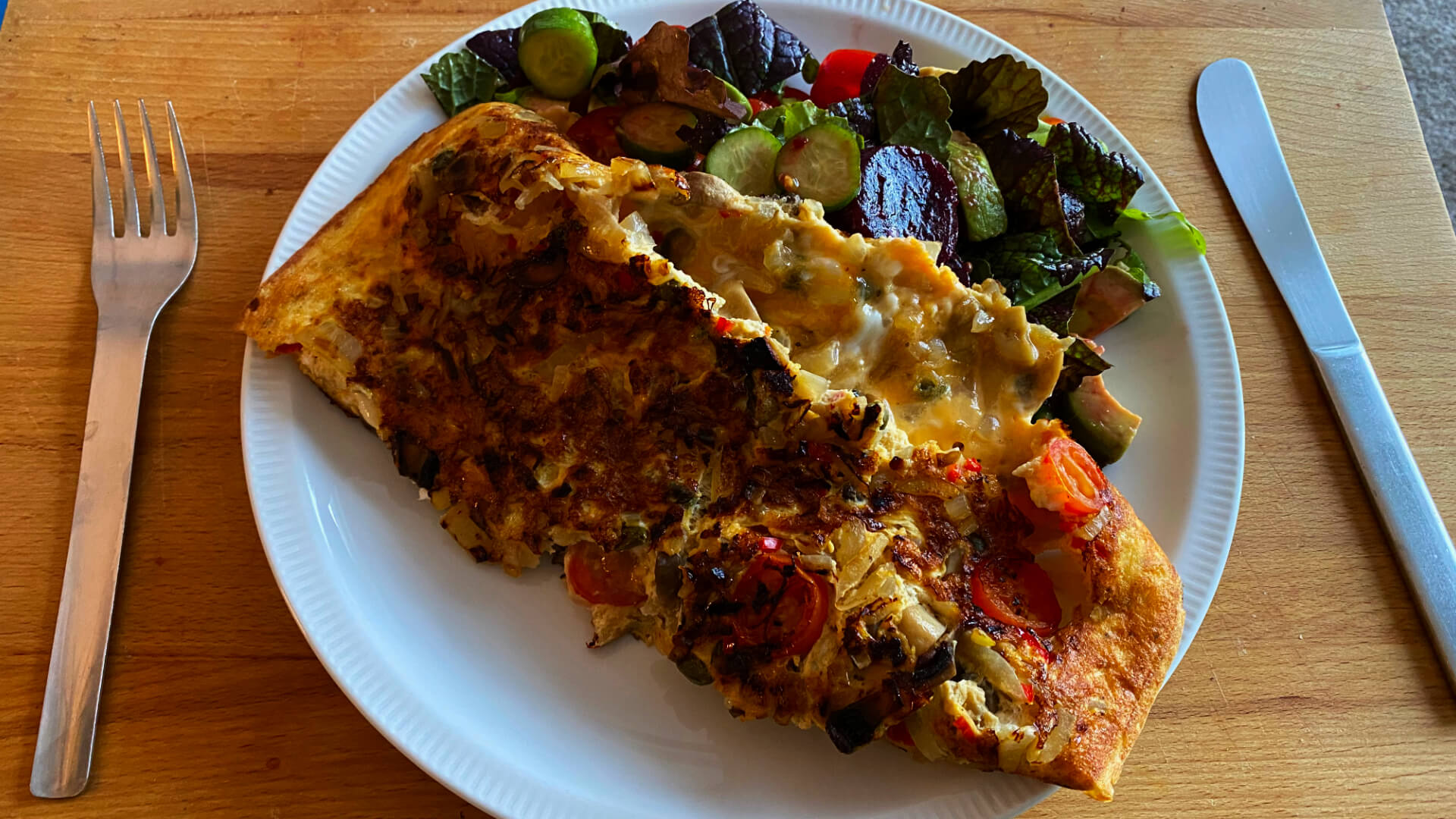
For your evening meal on your walking day, it’s good to focus more on protein and vitamins than carbs and this then forms your basic structure of food group consumption – carbs before, protein after. A great meal might be a large omelette with mushrooms and cherry tomatoes and a mixed non-leaf salad on the side or fish or chicken with rice and mixed vegetables. You don’t need to avoid carbs, it’s just that they’re not essential and so it’s better to focus on proteins, vitamins and other beneficial compounds because they’re going to give you more beneficial support for your physical recovery.
So, these are the key approaches for before and after your scheduled walking days but what about the days in between? Well, if you’re going walking strongly every other day, the days in between your walk days are your pre-walk days and so you simply rotate between protein rich meals and carb rich meals. But if you have longer periods between strong walks then you want to basically achieve a happy balance but don’t worry about getting enough of either carbohydrate or protein. Just, simply, seek to have some lean meat or plant protein, as many vegetables as you can and something with some carbohydrate, like potatoes, rice, bread or pasta as a side.
As you can probably imagine, for periods between exercise sessions, when you’re not just preparing for your next session, you want to get a good balance of all the essential food groups but the most important thing to remember here is that carbs are only really needed as the dominant component of a meal before you exercise – so the night before and for breakfast. At other times, if you’re not working out, it’s better to minimise carbs or for them to be a small component, so that your body is able to use them completely, not store any excess because that’s what turns to fat.
The fundamental thing to remember though is that if you’re following a program of strong walks, either as a fitness focused Sport Walker or as someone training for a challenge, you will be burning more calories than if you’re sedentary and that means that as long as you keep your portion sizes sensible, focus on food as fuel and with a rotating priority for either carbs or protein, you’ll be building yourself a good nutritional approach that can support your goals.