
Time is something almost all of us would like more of and probably feel that we’re deficient in. It especially becomes an issue when we take on a new activity or seek to make positive changes in our lives – there seems to be just too little time to really make it work.
The old phrase ‘life gets in the way’ is quite appropriate in this respect and it’s probably quite accurate. It’s not necessarily that we literally don’t have enough time, it’s just that day to day life – things we do automatically without thinking or things that are necessary for our lives to function properly – take first priority and this then feels like we can’t fit anything else in.
There are plenty of ‘declutter your life’ plans out there that can give you inspiration to make changes to those core elements you perhaps do on autopilot and this can be a truly beneficial thing to do. After all, if life is getting in the way of the things you really want to do, finding a way to change that is a good idea. If you can ensure that everything you have to do is efficiently ticked off and only takes the amount of time necessary, then that will leave you more time for the nice stuff.
Well that’s the big picture taken care of but to be honest, that stuff is really rather macro and can be very involved. Here at Sport Walk, we prefer to offer simple, practical ideas that are easy to implement and that means you can perhaps adopt them straight away while you work on the bigger, harder stuff. Anyway, we’re all about Sport Walking, not time management, so we’ll leave that to the lifestyle gurus!
So let’s dive in then and look at five things we think can make a big difference in making it easier for you to fit Sport Walking, or exercising in general, into your hectic life.
Plan, plan, plan, plan, plan (repeat as necessary)
We all know the phrase “failing to plan is planning to fail”? Well there’s some truth in that but in the cold light of day, what planning gives you is the ability to see everything laid out, to see how it all fits together (or doesn’t as the case may be) and what you need to do about it.

That’s the overall pitch for planning things out more but in terms of Sport Walking or building a fitness routine into your daily schedule, we’re talking more about where the gaps are or where they might be created, to make space for exercise and how to fit things together.
Planning your sessions starts with working out when you can actually do the sessions in the first place. Although planning overall in relation to Sport Walking or any other activity should have two components – big picture and day to day – it’s a good idea first to start with your day to day situation. If you can’t find a way to fit in an hour to go walking to your daily schedule, there’s not much point plotting out your journey to a buff bod six months down the line!
The first thing to do is to look at your day now. Be brutally honest with yourself about what goes on and then set out your schedule from the time you wake up to the time your go to bed. A good way to do this is to make use of the calendar you have on your phone and to put blocks of time in a day for each and everything you have to do.
You might think this is a bit excessive, I mean, you’re only trying to figure out when you can go for a walk but the thing is, when you’re seeking to fit something that needs to repeat regularly into your weekly schedule, if you’re not identifying everything competing for your time, then you’re not getting the full picture. To truly know if it’s possible to fit in an hour’s walk every other day, for instance, you have to know everything that’s currently stopping that from happening.
So set out your daily routine, giving the time you think you take for each element, then identify the gaps. Next look long and hard at everything in that daily schedule and mark up anything that’s not essential to your survival. Obviously work, childcare, family activities, food shopping etc are all essentials but perhaps ‘catching up on TikTok’ for an hour is more of a habit than a necessity?
So be really brutal and honest with yourself and clear out everything from your daily schedule that’s not essential. Then, place an hour’s ‘activity’ session in the most convenient place in the day, fitting it in around your essential activities. This will give you a schedule full of essential activities (including exercise because exercise is essential!) and everything will be laid out to take place at the right time. After that, whatever time you have left can be used however you wish.
This simple process of setting out essentials and then, essentially, adding one more essential – exercise – will help you prioritise your Sport Walking but more than that, you’ll be making a non-negotiable space for it in your schedule and that’s how you can make progress.
Start wearing trainers whenever you can
Far be it for us to propose a sartorial standard for you to adopt but there’s a big benefit with wearing trainers whenever you can. It means you’re ready to walk any time any place and that can help you save time.

You see, for the majority of Sport Walkers, a good strong walk around the streets will be as beneficial as hitting the trails for a similar time. It might not be ideal but at the end of the day, all that matters is that you get your time or distance target in and there’s no real practical problem in doing it wearing jeans and trainers.
Being a Sport Walker is all about your approach to walking, it’s not a uniform compulsory sport. There are no safety reasons why you must wear shorts or synthetic trousers, apart of course from the question of comfort. It’s certainly preferable to go Sport Walking wearing synthetic fibres because they’ll wick sweat away but it’s not a barrier.
If you’re wearing trainers and find yourself in a situation where you need to walk or can walk somewhere, then you can complete a portion of your allocated training session there and then. You’ve got the shoes on, you’re ready to go. This means that later on, after you’ve finished what you’re doing, you can then complete the time or distance target for that day and you’ve saved yourself some time.
If you’re not wearing trainers but there’s scope to walk somewhere, then even if you make a bit of an effort in your uncomfortable non-walking shoes, you’re not going to get the same outcome from the session. Either that or you’re not going to walk at all, so you’ve missed an opportunity to at least tick some time off your walking schedule and that means you’re going to have to do the whole session in dedicated time later.
In trainers, you can walk as you would if you were on a full training session, your only regulation might be about how much effort you make, perhaps because you don’t want to get too sweaty for afterwards. But even if you go easier than you would on a normal session, you’re still covering the distance, you’re still gaining and you’re still saving time.
Get dressed to train in the morning
This is a tip we’ve given quite a lot, especially in our courses – get dressed to go Sport Walking when you get up. Now, obviously we’re only talking about those days when you’re going to be going training and it is dependent upon it not being important what you wear for the rest of the time. If you’re going to a wedding for instance before you go Sport Walking later that day, then obviously this method isn’t going to work!

If your day isn’t giving you any reason why you shouldn’t be wearing sports kit though, get dressed to go Sport Walking as soon as you wake up. The reason we recommend this is because often things will come up during the day – distractions, crises, things that take you away from your schedule. If you have to get changed before going out walking and you’re running late, it can be really easy to think that you don’t have enough time left and so you bail and abandon that session.
If you’re already dressed to go Sport Walking and you get delayed then as soon as you’re free again, you can get straight out that door and start working out. You were delayed but you were still able to do your session. This tip is not so much about saving time as ensuring you don’t skip a session if you encounter time pressures.
Walk everywhere
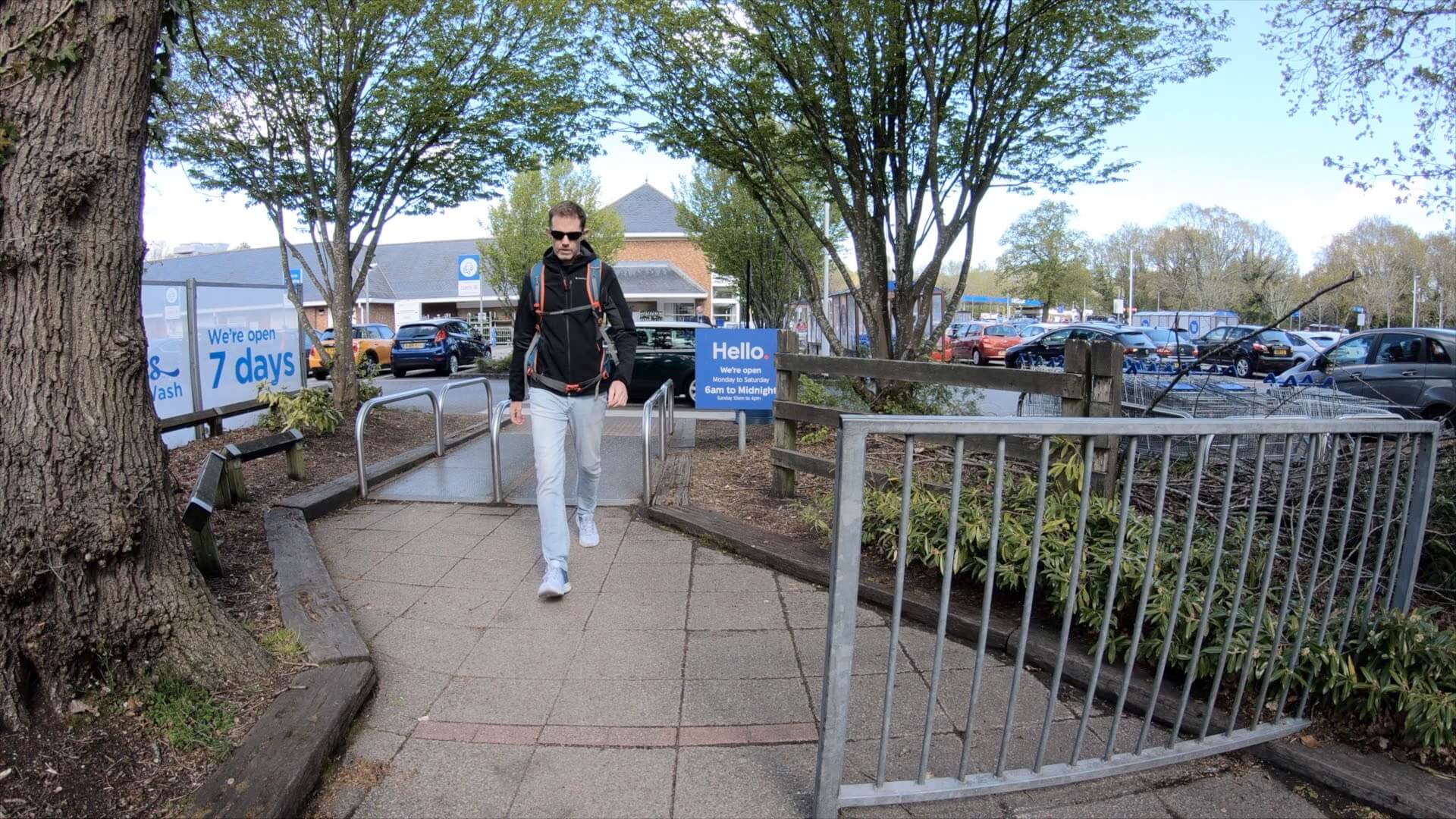
Another term we use a lot and for good reason. Adopting a principle of walking everywhere can give you the opportunity to combine training with household tasks, freeing up your planned walking session time for other things.

When you walk everywhere, we’re not talking literally but instead it’s about those local trips which perhaps you currently autopilot to using the car for. Zipping out to buy some milk, going to the Post Office to send off a birthday card, these sort of things. When you start to look at all the places you could walk to instead of drive, you realise just how potent this approach can be.
You may not save time in comparison with using the car but if you can use that trip to complete all or some of your planned Sport Walking activity that day, then you free up the time you would have used for a dedicated walk and that can, over time, turn into a super-efficient process, take it from us, we do it all the time!
Run walk
OK, this might sound like cheating but if you can run walk some sessions, then you can complete the session more quickly and save time. Now we can already hear some saying that this defeats the object of Sport Walking in the first place but go with us on this for a moment, all will become clear.

Run walking is an established method for runners seeking to improve their endurance and to be able to stay stronger for longer. There are various ways you can do it as a runner – you can just walk when you feel tired, you can walk at given distance points or you can walk whenever your heart rate goes over a specified threshold. But we’re not interested in why runners do it, we’re interested in how it can benefit Sport Walkers.
You see, this is not about avoiding running in case people discover they like that more than Sport Walking, this is about using running, jogging, call it what you like, tactically to add intensity to your training. If you run for periods when you’re training, as a Sport Walker, you’re going to gain fitness benefits faster than if you just walk and that can be beneficial if you’re looking to make quick progress towards a challenge goal.
Sport Walking is specifically a walking discipline, so there’s a non-negotiable rule that you should have one foot on the ground at all times but that’s just for when you’re taking on challenges or formal Sport Walks. When you’re working out or training, you can do whatever you want, if it’s going to be beneficial to your progress.
So mixing running with walking during normal training walks for a Sport Walker is a perfectly acceptable practice, provided they don’t forget themselves and break into a jog during a challenge! The added intensity of running, as we said earlier is good for building fitness but also, a big part of the allure of running some sessions or mixing running with walking is that you can get the work done more quickly!
Training is simply about preparing your body for something you’re going to take on at a later date, it’s not a performance or demonstration of technique, so as long as your training is testing you, pushing you and giving you benefits, everything’s good. So if you fancy running or jogging some parts of your sessions, go ahead and save yourself some time.
The only thing we do advise is that at the weekend when you go out for a longer Sport Walk, it’s best to complete this session just by walking because it’s an opportunity to put everything into practice and it’s like a mini-dry run for a challenge. So going out and functioning exactly as you will in a challenge is helpful because training is as much about training your habit as it is about training your body.
So, there we have it. Five simple, practical measures that you can easily implement to save time but the great thing about these measures is they reframe how you look at things and this will influence your approach in a broader sense. If you adopt one or two of these measures, you’re tuning into the potential to save time or make efficiencies in general and that means you’re receptive to other ideas that might pop into your head.
Time is precious and it’s important to give time to what’s important – family, health and wellbeing. By seeking to make ‘efficiencies’ in your life, to better enable the important stuff – like getting out and exercising – you’re committing to putting your health and wellbeing first and that’s a great step to take!
Leave a Reply