
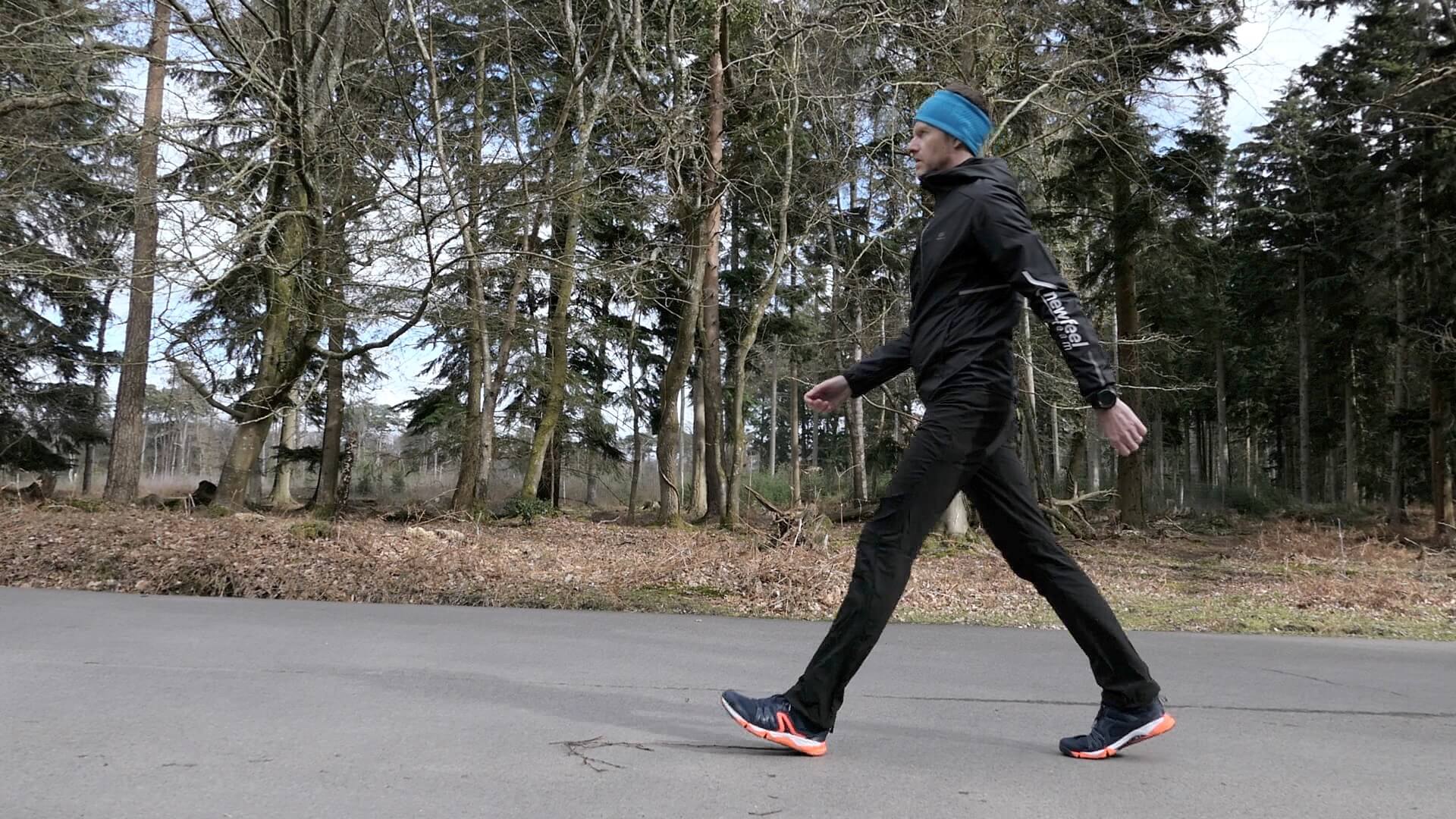
If you’ve taken on our Speed Test and revealed your true potential, you may be chomping at the bit to translate this knowledge into action in your Sport Walking. But knowing how fast you can or could walk is one thing, making something of all this potential is something else.
To fully achieve your potential in anything you need to be working towards goals but the whole field of goal and target setting can feel quite daunting if you’ve not engaged with it before, so let’s break it all down and work through the basics.

Goal or Target?
Often people get all in a tangle over the difference between a goal and a target. In theory, they could mean the same thing – you want to reach your goal and hit your target, so what’s the difference? Well, goals and targets have different purposes and it’s good to get this straight before you try and set yourself either.
Goal
In terms of practical applications, especially for Sport Walking, we’d consider a goal to be something that’s your ultimate end point, your objective or the overall achievement you want to make. While targets are the milestone measures you set, to help you progress and reach that goal. Now, you might say that a target is an end point as well but this is not just semantics, it’s about how the terms are used in the context of sport and, in this case, Sport Walking.

A good example of a goal is, in the context of fitness, being able to complete a ‘ParkWalk’ (from Parkrun) without feeling like you’re about to drop dead! Now this isn’t a very specific goal but it’s something tangible that you can easily relate to, measure and understand. Goals don’t have to be laser focused objectives, they can be quite broad but you must be able to know when you’ve actually achieved them.
It’s no good having a goal of ‘feeling fitter’. Fitter than what? A feeling is not something tangible that you can measure accurately and this is a really important aspect of goal setting – you need to be able to measure your achievement against the stated goal.
Completing a ParkWalk without feeling like you’re about to die IS something tangible you can measure: 1. Did you finish? Yes or no? And 2. Do you feel like you’re about to die? Yes or no? The feeling in this instance is different to ‘feeling fitter’ because it’s a secondary classification. The primary measure is whether or not you finished. But perhaps this goal example isn’t the most helpful.

A better example of a goal, in Sport Walking terms, is completing a certain distance within a given time. This is really common in challenge focused Sport Walking – completing, say, a marathon in under seven hours, something like that. It’s not about achieving an exact time – completing it in 6:45:32, although in theory you could set yourself such a specific goal as that but you’re almost guaranteed to fail. No, as long as you finish in under seven hours, you’ve succeeded, even if you cross the finish in 6:59:59!
Your goal might also be to reach something successfully. Perhaps it’s the summit of a mountain or the end of a marked trail, although usually, for challenges, you’d add a time classification as well but there’s no compulsion to do so.
Let’s imagine you have a goal of climbing Mt Kilimanjaro. As long as you reach the summit and get safely down again you’ve succeeded but a better goal perhaps or at least a goal for when you’re a little more experienced or further along your Sport Walking journey, would be to climb up to the summit of Kilimanjaro in under three days.
Now, with the general rule of thumb being that it takes five to nine days to reach the top and get down again because of the altitude and the long walk in, it makes reaching the summit in under three days quite a challenge but it’s possible if you’re in good shape and it’s a clear goal – you either do it or you don’t.
Target
So let’s look at the other side of things – targets.
Targets are just as valuable and important as goals but, as we’ve mentioned earlier, they deal with different objectives and are focused in on smaller milestones – the steps along the way that you pass through to get to your goal.
If you think of it like an actual journey, rather than the metaphorical kind so widely referred to in sport, you can’t just go “I’m going to leave home and then I’m going to arrive at my destination”. You need to go from road to road, pass through towns and villages along the way and, assuming you’ve got your navigation right, you’ll eventually reach your destination.
It’s exactly the same with a sporting or fitness journey. You reach your destination – your goal – by passing through milestones, it’s just that in the case of sport and fitness, these milestones are physical changes that represent progress. If you don’t set yourself achievable targets on your pathway to your goal, you’re making your overall task a lot harder. You’re seeking to go from your start point to your goal in one measurable step but that could mean that you’re likely to make less progress, simply because you’re not attuned to the gradual progress you are making.

Setting targets boosts your motivation and confidence because targets give you irrefutable proof that you are actually succeeding, even if you don’t feel that different or notice a major change.
For instance, you might set yourself a target of being able to complete your regular 5km weekday walks in under 50 minutes, breaking the 10 minute per kilometre mark. This target shows that you’re consistently walking faster than you did before, which tells you that you’re getting fitter. From there, you can set other targets to get below 9 minutes per kilometre and so on.
Targets, generally, are quite tightly focused and specific and this is also a good thing to remember in the distinction between a target and a goal. Think of an actual target or, to be more accurate, hitting an actual target with a bullet or arrow. It’s specific, narrowly focused and precise, whereas a goal is more about broader achievement.
Key targets to set yourself for Sport Walking would be mainly pace and distance related, often a combination of the two. Hitting a certain pace by a certain point in your plan will ensure you’re in a good position to be able to achieve the right pace for your challenge or fitness goal. Hitting a distance target also reveals that you’re getting stronger, faster and more capable.
The important thing to remember is that, just as goals are personal to you, so too are your targets. They’re simply the milestones you set yourself to achieve by certain points on your journey, whether it’s a fitness journey or a challenge journey. It’s about breaking the whole project down into smaller, more manageable chunks, so that you stand a better chance of success.
Setting Goals and Targets
So, lastly, how should you go about setting goals and defining the targets you need to hit to achieve them? Well, setting goals is pretty simple, it’s all about setting down something that you want to achieve, something that really means something to you and which you’ll be able to feel really proud of when (notice the positivity?) you achieve it.
You can set yourself goals for a whole range of achievement types, from time to complete an organised event to going further in a single walk than you’ve ever gone before. It could also be conquering something big that’s always held your imagination, like walking the Camino de Santiago or summiting an iconic mountain. It could even simply be a goal to go walking in a particular location, where actually making that dream come alive requires a significant amount of work or preparation, so it’s an achievement in itself.

Once you have your goal, you then need to identify what you’ll need to do to achieve it and once you’ve done that, you need to create targets that you need to hit at regular intervals, so that you know you’ll have made the progress you need. For goals, you can really just pluck them out of your head – they’re desires you have for things you want to achieve. Targets on the other hand need to be deeply rooted in fact and realism – its no good, for instance, setting yourself a pace target that you’re physically incapable of achieving.
So, for targets, you always work back from both the goal and the overall pathway you’ve identified you need to follow in order to reach it and then you say to yourself, “OK, if I’m going to be able to walk at this pace, in order to achieve my time goal, I’m going to have to be able to walk at this (different) pace by this point, otherwise I won’t have made enough progress”.
Essentially targets are just checkpoints for what you should be able to do, to make sure you’re on the right track. They should be absolutely and completely achievable otherwise there’s no point. Setting targets that you can’t hit is a pointless exercise that achieves nothing.
So, in summary, you can aim high and dream big with your goals, as long as they’re actually possible for you to achieve but your targets must be completely grounded in reality and be all about progress checkpoints to ensure you’re on the right track.
Leave a Reply